Hanoi, the vibrant capital city of Vietnam, is not only known for its bustling streets and rich history but also for its ancient temples that hold great spiritual significance. Among these sacred places are Hanoi’s Four Sacred Temples, each representing a cardinal direction and guarded by the gods.
In this article, we will delve into the meaning behind these temples, explore the legends surrounding them, and provide practical information for visiting these remarkable sites.
According to local folklore, the Thang Long Four Sacred Temples were established during the Ly Dynasty (1010-1225) in order to protect Hanoi from evil forces and ensure the prosperity of the city. Each temple is dedicated to a specific guardian and symbolizes one of the four cardinal directions: East, West, South, and North. Let’s explore these with 2 Vietnam!
Bach Ma Temple (White Horse Temple)
Bach Ma Temple, situated in the heart of Hanoi’s Old Quarter, is regarded as the protector of the eastern direction. Its name, which translates to “White Horse Temple,” is derived from a legend that tells the story of a white horse carrying a deity to this location. The temple’s architecture reflects a blend of Chinese and Vietnamese styles, featuring intricate carvings and vibrant colors.
- Location: 76 Hang Buom Street, Hanoi Old Quarter
- Opening hours: 8:00 AM – 11:00 AM and 2:00 PM – 8:00 PM every day
- Bach Ma Temple entry fee: Free
- Bach Ma Temple dress code: modest clothes that cover the shoulders and legs

The Legend of Bach Ma Temple – Hanoi’s Four Sacred Temples
Bach Ma Temple in Hanoi is dedicated to Long Do, an ancient deity who played a significant role in the history of the city. The temple’s initial construction took place in the 9th century to honor this deity.
Around two centuries later, when Emperor Ly Thai To decided to relocate the capital from Hoa Lu to Thang Long (present-day Hanoi), Long Do appeared in the emperor’s dream. In the dream, the deity informed the emperor that a white horse would emerge from the temple and roam throughout the city, leaving tracks that would indicate where the walls of the citadel should be constructed.

Emperor Ly Thai To heeded the deity’s instructions and followed the path left by the white horse. As a result, the construction of the citadel proceeded smoothly without any landslides or collapses. In gratitude for Long Do’s assistance, the emperor decided to relocate the temple to its current location and renamed it Bach Ma Temple, which means “White Horse Temple” in Vietnamese.
How to get to Bach Ma Temple
To reach Bach Ma Temple, you can take a taxi or walk if you are staying nearby. It is conveniently located within the popular tourist area of Hanoi’s Old Quarter, making it easily accessible for visitors.
Walking: If you are staying in the city center or exploring the Old Quarter, Bach Ma Temple is within walking distance. You can obtain a map from your hotel or use Google Maps to find the shortest route. It should only take a few minutes to reach the temple on foot.( Bach Ma Temple Google Map)
Motorbike: If you have a motorbike, you can start from Dong Kinh Nghia Thuc Square near Hoan Kiem Lake. Follow Hang Dao Street and then turn left onto Hang Buom Street. Bach Ma Temple is located at No. 76 Hang Buom.
- Bus: Several bus routes pass by Bach Ma Temple, including 01, 14CT, 18, 22A, 34, 18, and 43. You can check the bus schedules and stops near the temple to plan your journey accordingly.
Ride-hailing applications: Utilizing ride-hailing applications such as Grab or Gojek is another convenient option. Simply book a ride through the app and provide the destination as Bach Ma Temple. This ensures a hassle-free and comfortable trip to the temple.
You can see:
Voi Phuc Temple (Kneeling Elephant Temple)
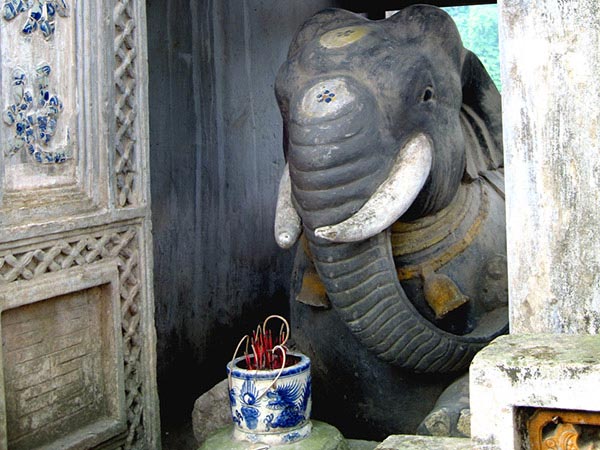
Voi Phuc Temple, located within the grounds of the present-day Thu Le Zoo, is a lesser-known historical site in Hanoi, Vietnam. It was originally constructed in 1065 on a muddy lagoon and now sits on a raised mound south of the zoo, offering a picturesque view of a large beautiful lake. The temple is surrounded by gardens and adorned with ancient trees, creating a serene and tranquil atmosphere.

The temple is dedicated to Prince Hoang Chan, who was also known as Linh Lang Dai Vuong. Prince Hoang Chan was the son of King Ly Thai Tong (1000–1054) and is revered for his contributions. Over the years, the temple has undergone significant damage during the period of French colonialism but was subsequently rebuilt.
- Location: 362 Kim Ma Street, Ngoc Khanh Ward, Ba Dinh District
- Opening hours: 8:00 am – 5:00 pm every week, especially on New Year’s Eve, the temple is open all night.
- Bach Ma Temple entry fee: Free
The architecture of Voi Phuc Temple
According to historian Le Van Lan, the architecture of Voi Phuc Temple represents the style prevalent in the 19th and 20th centuries. The design of the temple incorporates principles of feng shui, symbolizing vitality and harmony with the surroundings. Additionally, the square-shaped well within the temple grounds signifies abundance and prosperity.
How to get to Voi Phuc Temple
You can get to Voi Phuc Temple by motorbike, public transport such as a bus, or use Ride-hailing applications such as Grab, Gojek, etc. Several bus routes pass by Voi Phuc Temple, including 16, 27, 32, 34, 49
Kim Lien Temple (Golden Lotus Temple)
Kim Lien Temple, often referred to as the Golden Lotus Temple, serves as the guardian of the southern direction. This Temple is one of four Hanoi’s Four Sacred Temples
Kim Lien communal house and temple, also known as Cao Son Temple, is one of the four temples located in the ancient Thang Long Citadel in Vietnam. The four temples were strategically placed to guard the four cardinal directions of the citadel. Quan Thanh Temple protected the north, Bach Ma Temple guarded the east, Voi Phuc Temple secured the west, and Kim Lien Temple protected the south.

Kim Lien Temple is distinct from the other three temples in that it was built in a later period, specifically during the 16th and 17th centuries. This indicates that the temple was constructed after the initial establishment of the Thang Long Citadel. The purpose of Kim Lien Temple, like the other three temples, was to safeguard and protect the citadel.
The Legend of Kim Lien Temple
Kim Lien Temple is dedicated to the worship of Cao Son Dai Vuong, according to historical records. The temple houses a stone stele with the title “Cao Son Dai Vuong, god of compassion,” which was composed by historian Le Tung in 1510. This stele provides information about the significance of Cao Son god and the temple’s history.
According to the content on the stele, during the reign of King Le Tuong Duc, there was a rebellion that needed to be quelled in order to restore the inheritance of King Le Thai To. Three prominent ministers, Nguyen Ba Lan, Nguyen Hoang Du, and Nguyen Van Lu, led their troops to conquer the rebellion. As they arrived in the territory of Phung Hoa district (now the ruins of Lao temple, Van Phuong commune, Nho Quan, Ninh Binh province), they discovered a densely forested mountain with an ancient temple bearing the inscription “Cao Son Dai Vuong.”
Surprised by this discovery, the king and his officials sought the assistance of the Cao Son god. Miraculously, after ten days, they achieved success in their mission. In gratitude for the god’s help in suppressing the rebellion, King Le Tuong Duc constructed a temple to worship Cao Son in Phung Hoa.
Later, in 1509, the king rebuilt the temple to be larger and more beautiful in Kim Hoa ward, near the Thang Long citadel at that time (now known as Kim Lien). This indicates that the Kim Lien Temple was established as a grander replacement for the original Phung Hoa temple and became the focal point for the worship of Cao Son Dai Vuong.
How to get to Kim Lien Temple
You can get to Kim Lien Temple by motorbike, public transport such as a bus, or use Ride-hailing applications such as Grab, Gojek, etc. Several bus routes pass by Kim Lien Temple, including 21A 21B 25 28 35A 51 E03 E08
Quan Thanh Temple
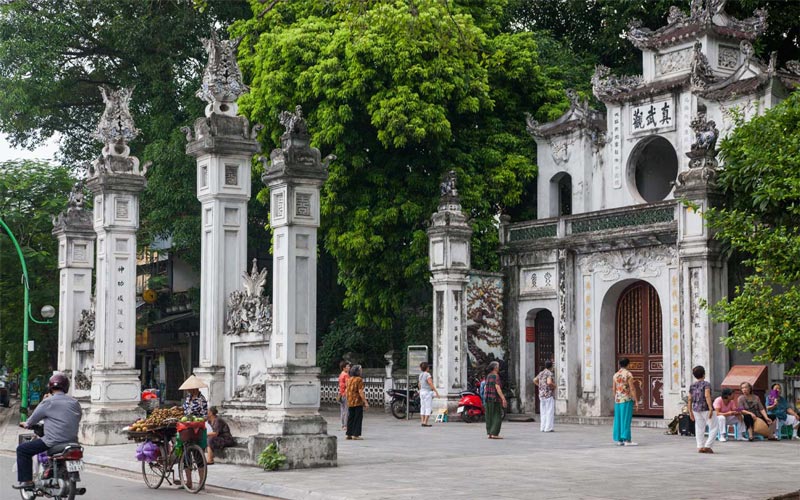
Quan Thanh Temple, known as the Guardian of the North, holds a significant place among Hanoi’s four sacred temples.
- Address No. 190 Quan Thanh Street, Quan Thanh Ward, Ba Dinh District, Hanoi. ‘
- Opening hours Weekdays: 8 am – 5 pm On the 1st and 15th of the lunar calendar every month: 6 am – 8 pm Open all night on New Year’s Eve to serve the needs of people worshiping and praying for peace.
- The entrance ticket price is 10,000 VND/per person. Note: Free for young children.
The Legend of Quan Thanh Temple
According to the legend, Huyen Thien Tran Vu was assigned the task of protecting the town of Bac Mon Thien Phu during the Tieu Dynasty from 589 to 600. He was believed to be the reincarnation of the son of the king of Tinh state, and he later renounced his royal status and wealth. Huyen Thien Tran Vu embarked on a spiritual journey, practicing asceticism on Vu Duong mountain.
After 42 years of rigorous practice, Huyen Thien Tran Vu achieved enlightenment and decided to travel to the region that is now Hanoi. He arrived at the Nhi Ha River in the Long Do village, which is present-day Hanoi. There, he entered a temple located on the West Lake and utilized his spiritual cultivation to eliminate various demons and evil forces, thereby protecting the people.
As a token of gratitude for his divine protection, the local people constructed a temple in the very location where Huyen Thien Tran Vu had practiced. The temple was named after him to honor his significant contributions to safeguarding their lives and well-being
How to get to Quan Thanh Temple
Visitors can choose from many different means of transport such as motorbikes, cars, taxis, buses, Grab… The temple is located in the city center area, so it is easy to find and move. If you go by bus, you can take routes 14, 33 or 50. These are all bus routes that stop very close to Quan Thanh temple, just a short walk to the place.
Hanoi’s Four Sacred Temples are not only religious and spiritual centers but also cultural and historical landmarks in Hanoi. They reflect the deep-rooted traditions, beliefs, and reverence of the Vietnamese people towards these deities and their role in safeguarding the city.