Geography Moc Chau, located in the southeast of Son La Province, is a border highland district, with an average altitude of 1,050m above sea level. It covers 1,072.09 km2 and is home to 113,937 people. Moc Chau borders Van Ho District to the East, Yen Chau District to the West, Phu Yen District and Bac Yen District of Son La Province to the North, and Sop Bao District, Houaphanh Province of Laos to the South.
With its mountainous terrain (Karst topography), in the North-West, Moc Chau is a land of undulating mountains and hills. Amidst these mountain ranges are the steppes, basins, ravines, streams, and rivers. Pha Luong is the summit, with an altitude of around 1.880 metres and the mighty Da River in the North has a lenghth of about 65 kilometers.
Moc Chau is divided into 4 main areas based on topography: Moc Chau plateau, the plateau belt area, the Da River area, and the border area.
Moc Chau plateau consists of 02 towns (Moc Chau Town and Moc Chau Farm Town) and 03 communes (Dong Sang, Muong Sang and Phieng Luong). This is a dynamic economic area with a focus on high-tech agriculture, production and processing dairy, tea and fruit agricultural products. It is the heart of the Moc Chau National Tourist Area.

The Moc Chau plateau belt area consisting of 5 communes (Chieng Hac, Tan Lap, Ta Lai, Na Muong, and Hua Pang) is characterized by hills and valleys interspersed between mountain ranges as well as a pleasant temperature. The development of agriculture commodities and community- based tourism is essential.
The area along the Da river includes 02 communes (Quy Huong and Tan Hop) with strongly fragmented terrain, focusing on developing household-scale agriculture, watershed protection forests, aquaculture, and fruit trees and developing river tourism and community-based tourism.
The Border Area which has a highly dissected topography includes the three border communes of Chieng Son, Long Sap and Chieng Khua. The area focuses on expanding small- scale agriculture, forest protection, tree planting for raw materials, medicinal plant planting, and cattle raising. Adventure tourism, which involves mountain climbing is growing near the international border with Laos in Long Sap. Commercial services are being established. It is noted for its cultural border markets
Climate
Moc Chau enjoys a mild, cool climate year-round with four distinct seasons. Its average annual temperature is around 18-20°C. Humidity regularly sits at 85-86%. Foggy days are common and Moc Chau can experience 80 days or more in a year which explains why it is over referred to as “the land of fog”-(“Muong Mok”) The most beautiful time to visit is from early autumn to early summer.
History
Under the Hung kings, Moc Chau belonged to the Tan Hung region, one of the 15 regions of the Van Lang state. During the Northern Domination period, Moc Chau was a part of the Chau Phong region. Under the Ly Dynasty (1010-1225) it belonged to Lam Tay and Dang Counties and during the Tràn Dynasty (1225-1400), it belonged to Da Giang county before coming under the administration of Thien Hung county.
According to Nguyen Trai’s Geographical Notes, the name Moc Chau dates back to the 15th century (during the Le dynasty), when it was one of five districts under the Gia Hung administration called Chau Moc in the county of Thanh Xuyen, Hung Hoa region.
In 1949, Moc Chau merged with Yen Chau District, before coming under Thai administration following the resistance war against the French colonialists. In 1962, Son La Province was re-established, and Moc Chau has since been under the administration of Son La Province.
On June 10, 2013, Moc Chau district was split into two smaller districts, Moc Chau and Van Ho. Consequently, Moc Chau district consisted of 13 communes and 2 townships. On June 14, 2019, Moc Chau was officially granted Grade IV urban center status (including Moc Chau town and Nong Truong Moc Chau town). This is the political, economic, and social center, as well as the tourist center of Moc Chau national tourist area. According to the plan, the district of Moc Chau is expected to become a town by 2025.
Moc Chau – A safe and friendly tourist destination
Moc Chau-A safe and friendly tourist destination Moc Chau has become a favourite destination for both local and international tourists, with its natural beauty, delicious local food, and friendly, hospitable people. Moc Chau tourism operators and the government are striving to protect its natural resources, local culture, and identity.
Moc Chau’s key tourist areas include forests, conservation reserves, diverse natural landscapes and ecosystems Including grassland steppes and tea hills, extensive cave and river systems, lakes, waterfalls, and valleys lush with white rapeseed flowers, wild sunflowers, and fruit trees. Four distinct seasons offer their own unique attractions including the flowering of peach and plum blossom trees.
Moc Chau – Rich in Cultural Identity
Moc Chau is home to 12 ethnic minorities. The ethnic groups are settled in small, intertwined mountain villages. The residential characteristics have created a rich and diverse culture for the land of Moc Chau, with the exchange and inheritance.
Traditional Housing
There are two basic types of traditional houses: stilt and single-story houses. The stilt houses are built by Thai, Muong, Kho MU, and Xinh Mun ethnic groups, while the single- story houses are mainly built by Kinh, Mong, and Dao ethnic groups.
Costumes
Moc Chau ethnic groups have unique colorful costumes worn during holidays and festivals. Women’s costumes are elaborately and beautifully decorated, reflecting their aesthetic sense, ingenuity, talent, and unique ethnic cultural identity. The decoration on the costumes all seeks to project elements of the animal and plant world.
Cuisine
The cuisine of Moc Chau is a delicious melting pot of rich ethnic diversity. Fresh, local ingredients are at the heart of every meal, creating dishes infused with indigenous culture and flavor.
Beliefs
The ethnic community in Moc Chau believe that “all things have a soul”. Agricultural rituals are held regularly in spring and autumn, praying for favorable weather, good crops, and people’s well-being.
Literature and Folk Art
All ethnic groups in Moc Chau have their own distinct identity – Mong, Thai and Dao ethnic groups even have their own script. Folklore storytelling reflects the work, traditions, and history of their culture and identify and praises for the couple’s love and family affection. Each ethnic group has its own folk-art treasure, containing its thoughts, feelings, and perceptions
Moc Chau – Bustling in the Festive Seasons
There are many traditional annual festivals celebrated in Moc Chau villages. Each festival is a place to honour ethnic cultural identity with the bustle of music and brilliant costumes. Festivals include:
- Mông- Nao Xong Festival and Sacred Stone Worshiping Festival
- Thái- Praying for Rain Festival, December, Muong Sang Commune.
- Het Cha Festival – February 15 of the lunar calendar, Dong Sang Commune
- La Ha-Pang A Festival-March of the solar calendar, pray for a good cro
- Dzao – New Rice Festival 5 and 10 of the lunar months, Phieng Luong and Tan Lap Communes.
Other notable festivals and events are:
- The Hot Air Balloon Festival Valentine’s Day February 14
- Tea festival in April
- Fruit Picking Festival in May
- Orchid Festival in June Other festivals include the Ethnic Cultural Festival – Independence Day held annually on National Day, September 2, and Moc Chau’s Miss Milk Cow Beauty Contest in October.
Moc Chau – Brilliant and Blooming in all Four Seasons
At the end of winter and the beginning of spring the plateau glows with the scent and colour of flowers, which blanket the beautiful steppe landscape landscape and are a magnet for visitors.
Apricot and Plum Blossoms The blossoms are synonymous with Moc Chau – it is a beauty that cannot be replicated.
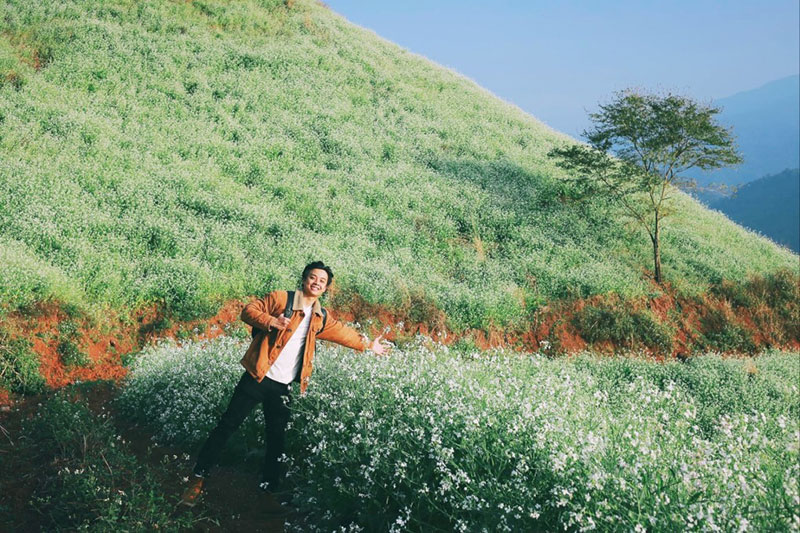
White Canola Flowers
From October to December, Moc Chau plateau is bathed in the pure beauty of white rapeseed flowers and aglow with the gold rapeseed flowers which cover the hillsides, extending from the valley to the feet of surrounding mountains.
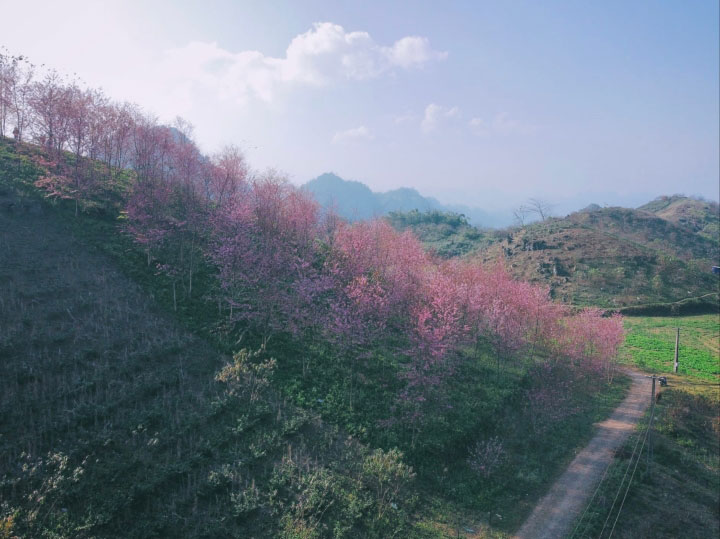
Peach Blossoms
Moc Chau has many varieties of peach blossoms from Da Lat’s Prunus Cerasoides, to cherry blossoms from Japan, but the most beautiful is “Dào Phai” (Prunus persica)
Camel’s Foot (Bauhinia) Flowers
A symbol of purity of the North-West mountains and forests that appears every spring.
Orchid Flowers
The queen of flowers with many varieties. The Orchid Festival is held every June attracting orchid lovers from far and wide.
Golden Shower Flowers (Cassia Fistula)
The bright yellow colors of the Cassia Fistula shimmer in the sun like beautiful lanterns in the blue sky, creating golden pathways of petals for pedestrians. The blooming season of the flowers lasts from May to June.Sunflowers This kind of flower represents faith, sincerity, longevity, optimism, hope, and looking forward to the future.
Wild sunflowers
This flower with the wild beauty is a symbol of Moc Chau in late autumn and early winter. Its bright yellow colour glimmers through the fog and shines in the sunlight attracting many visitors.
Buckwheat flowers
Juxtaposed against the green of the trees and blue of the sky, these purple, white and pink flowers blanket the ground.
Daisy Flowers
Under the canopy of plum trees and apricot trees, the daisies bloom incredibly romantic! i
Local specialties and delicacies
Moc ChauTea
Moc Chau Milk
Fruits
Cordyceps – medicinal herbs
This medicinal-like herb has been successfully cultivated since 2015. It is used to prepare health- promoting remedies and support wellness.
Five-colors of Sticky Rice (Sticky Rice of Love)
Bamboo-tube
Sweets & Cakes
Stream Fish
Salmon
Double-folded Grilled Fish (Pa Pinh Top)
Smoked Meat
Sour Meat
Free-range pork
Fried Veal
Free-range Chicken
Horse Meat Soup (Thắng Cổ)
Mong Mustard Greens
“Mán” Taro
Bitter Bamboo Shoots
Nậm Pịa
Water-taro Soup (Bon Soup)
Chẳm Chéo
‘Hoẵng’ Wine of the Dao Tien People
Hán sauce
Must – Visit Tourist Atrractions
With a total length of 632 meters, Bach Long Glass Bridge, which has gained a Guinness world record resembles a white cloud road connecting the mountains. Dressed with the French Saint Gobain see-through super tempered glass, sparkling light-reflecting hues in sunlight the bridge stands out among the mountains and wide.
A large amusement park complex built on natural terrain with European-standard games inspires uplifted feelings with conquering experiences: Alpine Coaster, Zipline, Bungee jumping, Rope Course, Trampoline, Hot air balloon, 5D interactive indoor amusement park complex, 5D virtual reality game, Air Slide, Climbing, Go Kart F1 race track….
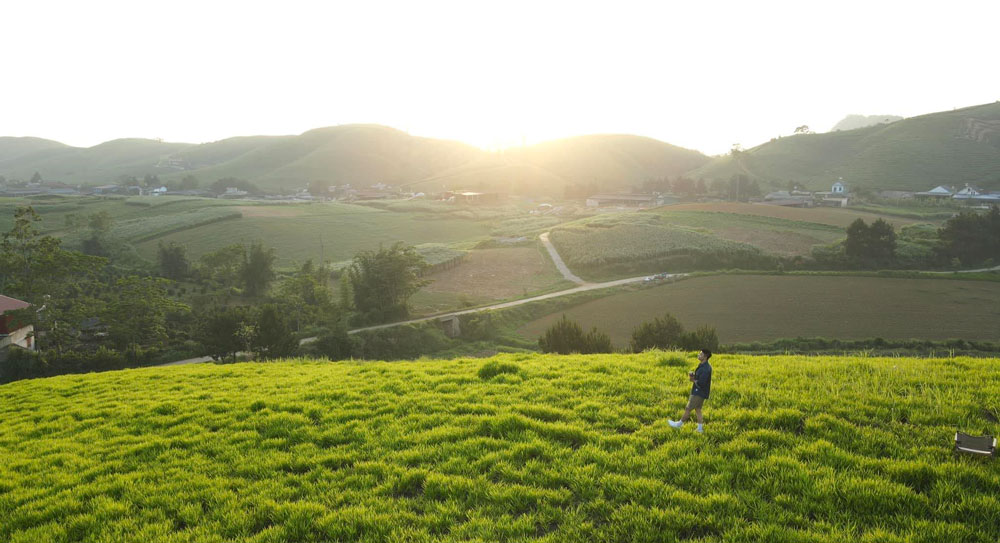
The 15,000m2 bow-shaped square, which hosts huge festivals and events, has a capacity of 25,000 people. Guests can enjoy entertainment shows in the evenings.
With 300 rooms, the accommodation system has a distinct design style: Northwest luxury villas; a highlight of the system of hotels with unique architectural style is the see- through infinity glass bottom. This is the first of its type in Vietnam. The 5-star hotel cruise features full-day entertainment.The Bullet Train Hotel blends with the Glamping Area, which is segregated with overnight activities for young people.
To get to Moc Chau island, head out of Moc Chau town on National Highway 43. At a point 3 km from town turn right and continue for about three km. You have the option of travelling easily by motorbike, car, or public bus. It is best to visit Moc Chau Island in the early morning to get the most out of your visit to the area. Make sure that you dress comfortably and wear sport shoes to walk around. It is open from 8:00 am to 10:00 pm
Pinewoods Back to the Fairyland
With its well-known natural beauty, the pinewoods in Ang Village are a popular tourist attraction. It is in Dong Sang Commune, Moc Chau District, Son La Province. This is a 5- hectare lake that was built in 2005. The lake is known as the Ang Village Pinewoods Lake because it is surrounded by a pine-woods that covers about 50 hectares.

The pinewoods in Ang Village, which have been planted since 1965, contain both native and horsetail pines (Pinus massoniana). The development of pinewoods has resulted in a sub-region with a pleasant climate and fresh air.
Located next to the lake, Phoenix Park is an entertainment paradise for people of all ages with a variety of modern and exciting games. For young people, there are numerous thrilling activities available, like the Ferris wheel, flying carpet, and APOLLO spaceship, as well as relaxing on the giant Sun Wheel with a panoramic view of the pinewoods from above. Children can play with the Royal Palace Tram and the Royal Ferris Wheel for free. In addition, guests can play golf across the lake for the first time in Vietnam.
Walking Street – Night Market “The Place for local cullture
A tourist attraction that covers an area of about 2.3 hectares, located in the center of Moc Chau Farm Town. Tourists can immerse themselves in the cultural space of the Northwest mountains and forests, experience interesting architecture with ancient and nostalgic features, which brings together many cultural architectures of Moc Chau ethnic groups and the world such as Northwest stilt house conservation center, Tam Quan Citadel, Japanese old town, Hong Kong old town, and art street and Northwest market.

In addition, there are a Northwest cultural and historical museum, an ancient train station, a Koi fishpond, a cherry blossom garden, a Northwest ancient peach garden, a white camel’s foot flower garden, a love stream, and other attractions are available. Other interesting places include the display area of artifacts introducing the national cultural identity as well as a venue for cultural and artistic performances, the dining complex, the street for selling ethnic brocade products, snacks, and fast food; streamside houses, Moc Chau agricultural products sales area, streamside restaurants, and many other items.
Along the road that follows the Ang stream of almost 500 m, there are 5 entrances for pedestrians. On the walkways, visitors can admire, appreciate, and photograph floral gardens, architectural masterpieces, cultural galleries, and agricultural products.
Each object serves a distinct purpose, but they are all designed in an open manner, in immediate contact with the surrounding nature and landscape; and bears the imprint of Moc Chau plateau. The location is around 200 meters from the Moc Chau Trade Union Hotel.
Dai Yem Waterfall “The Symphony of Love”
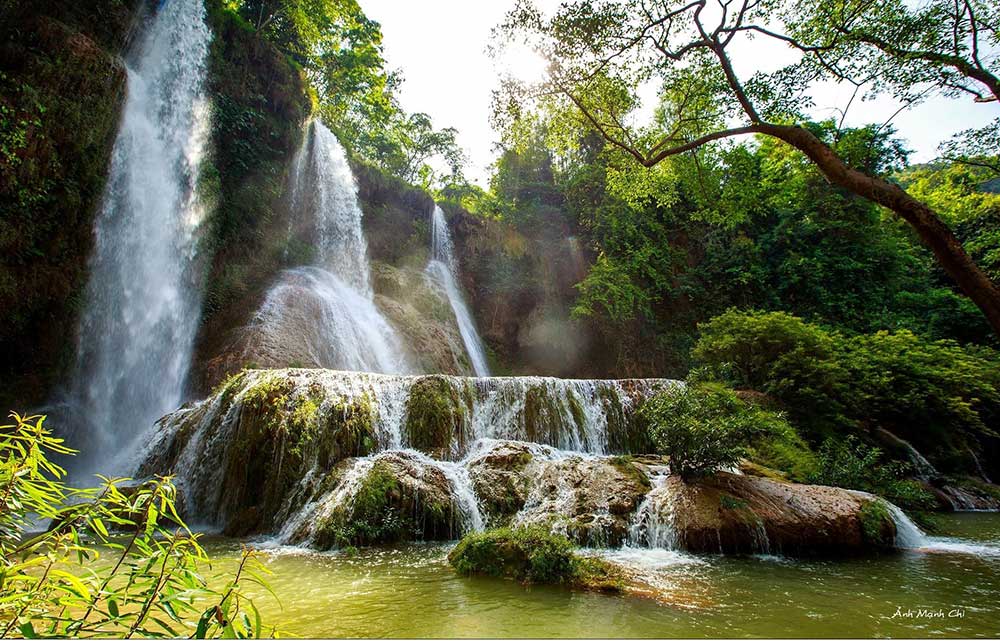
Dai Yem Waterfall (in the Thai language, it is known as “Sai- péng”: The Bond of Love), or” Nang Waterfall”, “Ban Vat Waterfall”, located in Vat Village, Muong Sang Commune, Moc Chau District. The waterfall was recognized as a provincial-level relic in 2015.
The waterfall is approximately 100 meters tall and is separated into two branches, one with nine steps and the other with five; the two branches are around 200 meters apart. It tells the moving love story of Sa Bun and Uoi Nga. When the boy, Sa Bun, set out to fight the enemy, the two young lovers met by the waterfall and made an oath forming the bond of love. On the victory day, Uoi Nga waited in vain for him to return, her tears falling like a waterfall, her call echoing throughout the mountains. Since then, the waterfall has become a symbolic place for faithful love; and a place for lovers’ oaths.
Right next to Dai Yem Waterfall is the first 5D-effect glassbridge in Vietnam. The bridge is nearly 100 meters long, two meters wide, 22 meters high, using the most advanced 5D- effect glass technology with a 3.2-sensitive eye system with 30 effects. This 5D-effect glass bridge now holds three Guinness Vietnam records: the bridge with the largest steel coupling heart cluster, the biggest visitors’ book, and the largest lotus- shape pillar.
Visitors can easily ride a motorbike or a car from the district center by following National Highway 6 towards Son La for about 3 kilometers to the intersection of the road to Long Sap, in the direction of the left of National Highway 43 for about 5 kilometers. That area is part of Vat Village, Muong Sang Commune, Moc Chau District. To get the most out of your visit to the area, carry the following items with you: umbrellas, hats, and low-heeled sandals to move and wade.
Girls should choose appropriate outfits and dress appropriately when visiting the glass bridge. Tickets to the Falls: VND 50,000/ ticket Glass bridge tickets: VND 100,000/ticket. Dai Yem Waterfall is open every day of the year. Spring – Sumer hours (January 1 to June 30): 7:00- 17:30; Fall-Winter (July 1-December 31): 6:30-18:00.
Chieng Khoa Waterfall
Chieng Khoa Waterfall is also known by other names such as Nang Tien Waterfall, May Waterfall or Na Tra Waterfall. The waterfall is located in Chieng Khoa commune, Van Ho district, Son La province. The waterfall is about 24km from the center of Moc Chau district to the east, in the direction of Van Yen ferry.
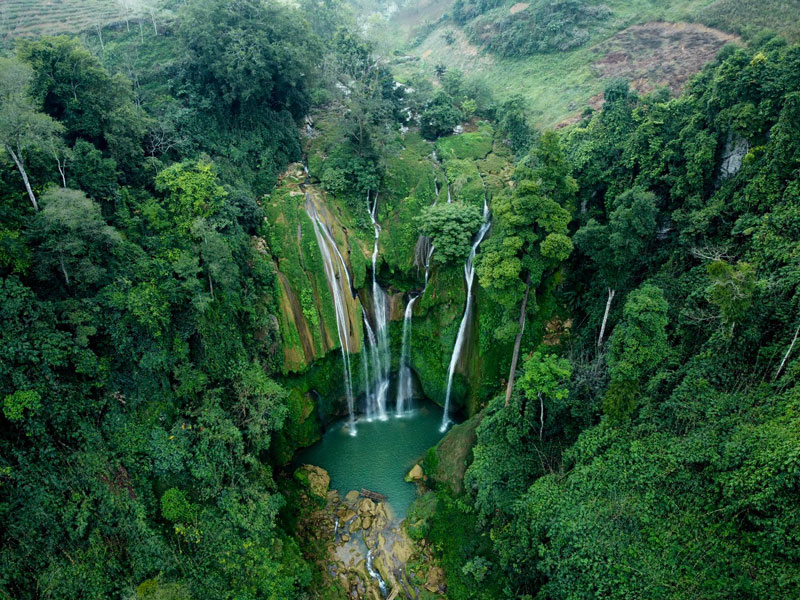
The name of this waterfall is associated with a famous legend from the Hoa Ban festival of the village of Xen Ban – Xen Muong. Since ancient times, when people discovered this waterfall, at first glance, the waterfall was as beautiful as a white silk cloud stretching across the top of the mountain, down to the deep valley. The rushing water is white, creating a magical mist that covers it like the white mists of clouds. Since then, people named Thac May – or Chieng Khoa Waterfall.
Bat Cave Relic The wonder of nature
Bat Cave is a familiar name used by the people because it is home to many large flocks of bats There are also other names such as Son Moc Huong Cave, Tay Thien De Nhat Dong (The most beautiful cave under the Western Sky). It is one of the most beautiful natural caves in Son La Province with an area of 6,915m2 hidden under the overlapping Rocky Mountains. In the heart of the mountain, there is a large underground water source, that serves as the source of domestic water supply for the town.
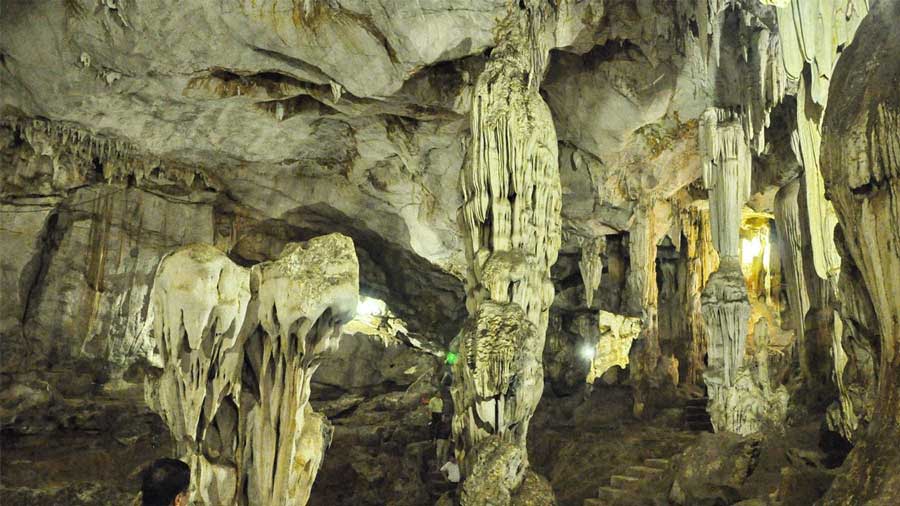
There, stone tools dating back thousands of years were discovered. During the resistance war against the French, the cave was the shelter of the Tay Tien army, Regiment 174 under Division 316 for reinforcement for the northwest campaign and the Dien Bien Phu campaign. During the anti-American resistance war, the cave was the place where Division 335 was stationed and stored weapons. Right at the entrance of the cave, there are still autographs of soldiers: “It is better to sacrifice everything for the sake of the Fatherland.
” In 1998, the Bat Cave was recognized by the Ministry of Culture, Sports, and Tourism as the National Landscape Heritage. It is best to visit the Bat cave in the morning and it is necessary to prepare drinking water, offerings, soft hats, low-heeled shoes, and sandals. Because there are spiritual places in the cave, proper attire is required.
Bat Cave is located on Tran Huy Lieu Street, Sub-zone 8, Moc Chau Town.
- Entrance ticket: VND 20,000/ticket
- Opening hours 7:00 am to 17:30 pm, all days of the year.
Tay Tien Regiment 52 Monument Once and for all
In 2006, the historical monument and memorial site for Tay Tien Regiment 52 were built at Na Bo Hill, Moc Chau Town, and they were later renovated and refurbished in March 2015. In 2017, the Ministry of Culture, Sports, and Tourism designated the memorial site as a National Historic Heritage. The work’s distinguishing characteristic is the park design concept, which is based on the content of Quang Dung’s poem “Tay Tien” is and divided into three areas: traditional house, battle symbol, and song of triumphant return.
The relic honors the Tay Tien army heroes who gave their lives for the independence and freedom of the Fatherland, for the people’s happiness, and for the friendship between Vietnam and Laos. Following in the footsteps of the Tay Tien army in the past, tourists will experience many emotions when listening to the touching stories of the Hanoi lads in the early years of the arduous resistance war against the French.
There, tourists can express their gratitude to the previous generation, view a part of Moc Chau town, and enjoy the serene and pleasant atmosphere while listening to the triumphal music. You can drive by motorbike, car, or public bus. There are on- site guides for tourists.
When you arrive, the order in which you should visit is as follows: Visiting the traditional room; offering incense to pay tribute to the soldiers of Tay Tien; visiting the monument. It is open from 7 am to 5:30 pm, every day of the year. The entrance fee is VND 20,000
Moc Ly Fort Immortal epic
Moc Ly Fort was built by the French in 1951 in a strategic location, at the crossroads between Hanoi and Son La, and from the Northwest to Upper Laos. The fort is a set of fortified fortifications that includes a command post, three guard posts, and nine blockhouses that are connected by a system of trenches, to keep our troops from advancing to the Northwest and Upper Laos.
It is regarded as: “The impregnable iron armor”. In 1998, the Ministry of Culture, Sports, and Tourism designated the Moc Ly Fort as a National Historic Heritage. It is recommended that you bring low-heeled shoes and sandals, neat clothes, soft hats, and umbrellas to protect yourselves from the rain and sun.
Because the path to the blockhouses is small and narrow, and certain sections lack handrails, you should indeed request a guide from the Management Board. If you are travelleing with children you must use caution and care when admiring the scenery and taking pictures as there are many unsafe cliffs at the top. It is open from 7:30 am. to 5:00 pm. every day of the year. The entrance fee is from VND 20.000 to 30.000.
Vat Hong Pagoda
This is the oldest pagoda in the Northwest; historically this place used to be the Buddhist center of the whole Northwest of Vietnam. Chien Vien Pagoda was designated as a provincial level cultural and historical relic by the People’s Committee of Son La Province on February 27, 2013. The pagoda is more than 700 years old, and it is the only pagoda in the Northwest region with typical architecture of regional cultural interference and harmony between Buddhist teachings and local culture.
The pagoda houses several Lao Buddha statues or locally made imitations of Lao Buddha images, dating from before the 19th century, all of which belong to the Theravada sect. The pagoda was renovated, embellished, and completed in 1909 by Mr. Sa Van Ky – the district chief of Moc Chau with contributions from residents both inside and beyond the district. Thanks to the contributions of the Buddhists and residents the pagoda was encircled, and its walls and precinct were expanded in 2016.
Currently, Chien Vien serves as a spiritual center for mountain villages, is known for the ‘Chách Vắt’, ‘Chách Và’ festivals, which take place on the fifteenth of April, according to the lunar calendar. The pagoda is located in Vat Village. To get to Happy Land Moc Chau, head out of Moc Chau town on National Highway 43. At a point 3 km from town turn left and continue for one km. The road is accessible by personal motorbike, personal car, or public bus.
Historical-Cultural Places of Interest
The historical site where Uncle Ho talked with officials and people of the ethnic groups in Moc Chau District Thanks to the design of a small park, the site is in harmony with the landscape and provides open space while ensuring solemnity, warmth, spirituality, and closeness to meet the expectations of the people of the ethnic groups in Moc Chau District.
The historical site where Uncle Ho met with officials and workers of Moc Chau Farm Town The relic site is one of the historical vestiges, a place to preserve Uncle Ho’s affection for the people of Moc Chau, and a place to teach revolutionary traditions for younger generations of the ethnic groups in Moc Chau District. With a charming landscape with a lake in the front and a high mountain with a beautiful location behind it, it is an ideal place to capture moments of Moc Chau plateau.
The relic was designated a provincial level historical relic by the People’s Committee of Son La Province in 2004. The site is at Kim Lien Street, Sub-zone 19/5, Moc Chau Farm Town.
Water Well of Regiment 280
The Water Well of Regiment 280 is of cultural and historical value in the locality. It has been a symbol of the Farm workers’ solidarity and determination to overcome hardships since the early days of Moc Chau Farm Town’s establishment.
The water well was dug by the officers and soldiers of Regiment 280 beginning in 1958 and is a memorial to 1,700 officers and soldiers of the Regiment 280 as well as more than 600 officials and workers of Moc Chau Farm Town. The work is related to the formation, construction, and development of Moc Chau Farm Town. The relic was designated a provincial-level historical relic by the People’s Committee of Son La Province in 2016. The site is at Sub-zone Agency of Moc Chau Farm Town.
Regiment Monument 83 for Vietnamese volunteer soldiers in Laos
The monument’s construction began in October 2001 and was completed in March 2002, covering an area of 1,299m2.
The Monument is in the community-based tourism village of Ang Village, under the canopy of an ancient banyan tree (locally known Săn Co Pho) in Dong Sang Commune, Moc Chau District. Regiment 83 is a unit with many achievements in fighting to help Vietnam’s brother country Laos in the resistance war against the French colonialists. The regiment was twice conferred the title Hero of the People’s Armed Forces.
The Monument was designated a provincial level historical relic by the People’s Committee of Son La Province in 2004.
The Five Caves in On Village
The Five Caves in On Village were designated a provincial level historical relic by the People’s Committee of Son La Province in 2008. The Five Caves in On Village are located in the On Village Sub- zone, Moc Chau Farm Town.
Adventure Tours on Pha Luong’s Summit “Dance of the sky and clouds”
Pha Luong Mountain in the Thai language is known as “Bo Lung” which means “great cliff” and is located 30km southeast of Moc Chau Town in Chieng Son Commune. Pha Luong, often known as the “roof of Moc Chau”, is located on Highway 43, which leads to the Long Sap international border gate.
Moc Chau’s Pha Luong Summit is one of the extremely attractive sites for those who love exploration and adventure travel. With the wild and majestic natural scenery among the mountains and forests. This attraction is a great site for young people, especially photographers, to go cloud hunting.
Pha Luong is situated on a border with the Lao People’s Democratic Republic, which is strategically important for national defense and security. The place is extremely valuable to the natural ecosystem as well as the conservation of rare and unique genes.
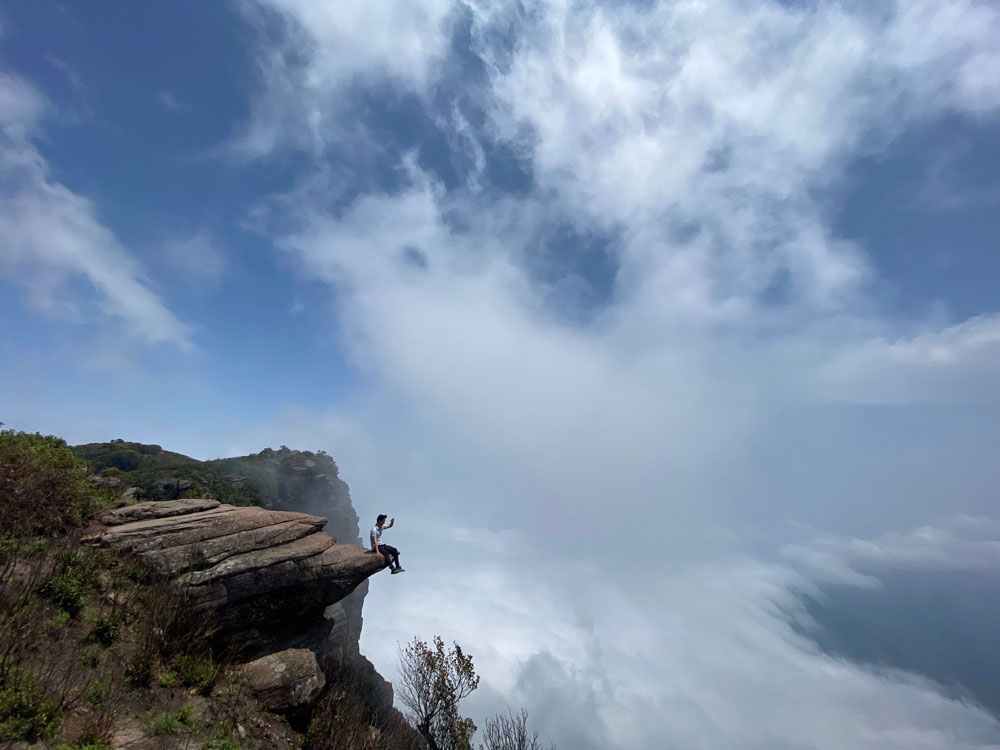
It is best to visit the summit early in the morning for the best tour and experience of Pha Luong Mountain. Because this is a border area, before departure, you must talk to a local guide to contact the border guard station for approval. You can travel by motorbike for 15km along Highway 43 from Moc Chau town to Long Sap border gate, then turn into Chieng Son Commune, travel another 12km to the guard post of Pha Luong Village, park your vehicle somewhere, and climb on foot for the remaining 4km to come reach Pha Luong. It is vital to have a local guide when travelling.
Because climbing activities are included, you must be in good health. Dress neatly and bring what you’ll need to make the climb such as water bottles, climbing sticks, tiny flashlights, multi-purpose knives, parachute cables, raincoats, and light clothes in your backpack.
You should not go alone and must adhere to the instructions of the guide. To avoid danger, do not approach the cliffs to snap photographs, join hands to conserve the natural environment, and do not litter indiscriminately after you reach the top of the mountain.
Grassland and Dairy Farm “Green grassland, healthy milk”
Dairy cows have been raised in Moc Chau since 1958. Every year, the dairy farm, which has nearly 600 households and 24,000 cows, produces over 70,000 tons of fresh milk. Moc Chau Milk Company has invested in a Dairy Farm where visitors can experience and learn about the process of caring for, milking, and processing high-quality dairy products.
Dairy farming and milk production here is conducted to the high standards of developed countries such as the US and Canada. Every year, the Miss Milk Cow Beauty Contest is held on October 15 to honor dairy producers and promote their products.
You’ll feel like a true dairy farmer, helping with the entire breeding process as well as daily activities like mowing grass, feeding, and milking the cows by yourselves, and enjoying a glass of hot milk in a beautiful space.
You must follow the farm’s regulations and will need to require a guide to visit the milking and care process. The Dairy Farm is located in Sub-zone 70 – Nong Truong Town. It is best to visit the grassland early in the morning.
Beautiful grasslands may be found in the Farm Town’s Sub- zones 70, 26/7, 68. The traffic is convenient, so you can travel by motorbike, car, or bus with 16-45 seats. It is open from 7 am. to 5:30 pm. every day of the year.
The entrance fee is VND 20.000/adult; VND 10,000/child. For hot milk: VND 10,000/cup. You should bring an umbrella with you and dress comfortably to walk around. Bring additional colorful costumes, or rent ethnic costumes to create wonderful shots.
Tea hill plantations
For soaring dreams Tea trees have been popularly grown in Moc Chau since 1958, primarily from the native Shan Tuyet tea. The tea hills are not only really the beauty of nature, but also the care of the gardeners. When visiting the tea hills in March and April, you will experience a beauty full of vitality of young green shoots.
MOC CHAU Visitor Guide 96 Tea village The tea hill plantations of Moc Chau tea company. Once you arrive, you will be able to see Shan Tuyet tea hills which more than 60 years are old and have been associated with the history of Farm Town since its first days of establishment. When you reach the top of the tea hill and look east at dawn, the scene will be very romantic. The tea village in Black Tea sub-zone 1, Farm town.
Heart-shaped hill tea plantation The main tea species grown here is Oolong, which has an average of about 20 years. A fingerprint-shaped tea hill, about 200m to the right of the heart-shaped tea hill, was planted by the people there to show their love for the land where they imprinted their fingerprints and sweat. The S- shaped tea lot is on the left side of the tea hill; from here, you can see the entire scene of the heart-shaped tea hill. The heart-shaped tea hill is 15 kilometers from the Farm Town.
Moc Suong Tea Hill
The tea beds look like fingers that wind around the hillsides as if on a giant brocade. During the tea bud harvest season, visitors will see groups of people lining up on the tea beds, creating a lively scene. It is best to visit the tea plantations in the early morning or late afternoon when the traffic is light, you can travel by motorbike, car, or bus with 16-45 seats.
You should bring additional colorful costumes or rent traditional costumes at the site to take beautiful photos. When you visit the tea hills, you will feel like a tea farmer, picking dew-drenched tea buds, experiencing tea drying, observing the process of tea production by machine and product packaging, and you will also have a chance to enjoy the art of making tea and enjoy warm cups of tea with the flavors of the hilly land.
Moc Suong tea hill is about 20 kilometers away from the Farm Town.
Agricultural Attractions
Moc Chau Tropical Flower Garden – Countless colors and fragrances.
Located in Ang Village, Dong Sang Commune specializes in growing special flowers that many people like and love to plant such as orchids, tulips, lilies, and Phalaenopsis.
Visitors to the flower garden will be able to see a grand and spacious farm with covered greenhouses, air conditioning, technology in watering, an hourly lighting system, and different varieties of flowers treated with molecular biology imported from the Netherlands and European countries. It is just 4km from Moc aChau center, you can travel by motorbike or car.
The fastest route is to head east on Phan Dinh Giot Street. It is free to visit every weak day, open from 7a.m. – 11:30 p.m., and from 13: 30p.m – 17:30 p.m. Visitors can buy or order flowers as a gift to family and friends
Chimi Strawberry Farm
Chimi is known as a high-tech farm, producing products such as Japanese Strawberries and Black Summer Grapes. As one of the first farms in Moc Chau to open for tourists to visit and pick their own strawberries themselves at the garden, it is in the pinewoods of Ang Village, Dong Sang Commune.
Strawberries can be grown in two ways: hydroponically or underground. Visitors will have the opportunity to plant, care for, and harvest strawberries, grapes, and vegetables. Chimi also offers a variety of strawberry-based dishes, including pure strawberry smoothie, strawberry yogurt, and a variety of processed products such as jam or dried strawberries.
To visit Chimi Strawberry Farm, take a motorbike or a car from the center of Moc Chau town for about 3 kilometers to the center of Dong Sang Commune; you can either drive a motorbike or a car. It is open to the public for free from 8:00 a.m. to 6:00p.m. Strawberry prices for tourists who wish to pick and buy strawberries range from VND 300,000 to VND 400,000. The best time to visit Chimi Strawberry Farm is during the fruiting season, which lasts from October to May of the solar calendar. Especially, from the end of December to March when the main crop of large and red strawberries begins to ripen.
Community-Based Tourism Villages
Doi Village – The convergence of people’s hearts
Doi Village (Bán Doi), in the Thai language, is known as Đàn Dói, which translates to a village located at the foot of a rocky mountain with red stripes from the top of the hill and it was then afterward renamed Bản Doi.
The village was founded in the 18th century. Today, the village is located in Tan Lap Commune, Moc Chau District, and features breathtaking scenery as well as traditional stilt house architecture, traditional Thai dance, and old tombs of the Xa people. This area would be ideal for the development of community-based tourism.
Tourists will participate in Thai ethnic community cultural activities, attend festivals, dress up in national costumes, and more. They can also engage in traditional games such as bamboo jacks, Tó Má Le, tug of war, Sap dance, or become a chef and cook dishes with mountains flavors. To visit the village, visitors can travel by motorbike, car, or bus along provincial route 104 for about 25 kilometers from Moc Chau Farm Town to Tan Lap, which is about 3km from Tan Lap Commune’s center.
Ta So Village
The village was founded in 1964 and is located in Chieng Hac Commune, Moc Chau District. At an elevation of over 1100m, Ta So village is known as the “Plateau of Plateaus”. This is a community-based tourism village that is committed to preserving the unique traditional culture. The wild and poetic natural beauty will provide visitors with awe-inspiring experiences during the travel to the mountainous region.
You may find yourself working like a blacksmith manufacturing labor tools or as a craftsman weaving handicrafts, embroidering a beautiful garment, or physically pounding and molding sticky rice to make round cakes (bánh dày). You will be immersed yourself in the village’s old surroundings, take part in a dance festival, throw a Pao ball, and play Yến.
Currently, six households, spanning from the beginning to the end of the village, offer homestay accommodations built in the Mong-style architecture. Some offer private rooms while others are dorms.
You can visit Hang Tau (tourists refer to it as the Primitive Village) which is renowned as the oldest village.
To visit the site, it is recommended to travel only by motorbike with a guide. You should travel during the day, should not stay the night due to the lack of electricity and phone waves.. To visit the village, you can travel by motorbike, car, or bus (up to 29 seats) along National Highway 6, in the direction of Moc Chau – Son La, for about 15 kilometers from the district center with a right turn to the village for about 7 kilometers on the concrete road. The road system to the village is a quite small concrete road.
Ang Village
In the Thai language “Ang” means “vessel”, the village was called for that topographical feature. Ang village is an old community that dates to the 16th century. The village, which resembles a large vessel is set in a flat valley surrounded by limestone mountains.
Ang Village is the first community-based tourism village in Moc Chau. It still fully preserves the traditional culture of the Thai people with the unique Hết Chá festival. Notably, the village is famous for its thousand-year-old banyan tree, a massive green pine hill, and a vivid tropical flower garden that blooms in four seasons. This is an ideal place for tourists to plan sightseeing excursions.
Many stilt house accommodations are available for groups in the village, with prices ranging from VND 70,000 to VND 120,000/person/night. Bicycle rentals, campfires, and cultural exchanges are all available. Visitors can reach to the tourist attractions of pine woods in Ang Village on foot, by bicycle, motorbike, car, or bus (of any kind) from the center of Moc Chau Town, by turning left along Highway 43 for about 3 kilometers.
Vat Village
Vat Village, in the Thai language, ‘Vat’ means ‘pagoda’ because there is an old pagoda in the village. Vat Village used to be the center of Muong Sang related to many stories about the history of Moc Chau’s land.
The village boasts a beautiful space that still preserves many traditional house architecture of the White Thai people. Visitors can travel by bicycle, motorbike, car, or bus from the district center along Highway 6 towards Son La Province about 3km to the T-junction of Long Sap Road, then turn left on National Highway 43 for about 7 kilometers.
Publishing Director
NGUYEN THI HOA – Vice-Chairwoman, People’s Committee of Moc Chau District Head, “Inclusive Tourism Destination Management Project” Steering Committee
Production Manager
DINH THI HUONG Head, Culture and Information Division, Moc Chau District
Person in charge of content
NGUYEN DUC NGUYEN-Head, Propaganda and Training Commission, Moc Chau District Party Committee
Editors – English language
Judi Lalor & Van Lam
Editorial board
- Ph.D. HOANG XUAN TRỌNG – Dean, Faculty of Economics, Tay Bac University
- Ph.D. DẠNG TRUNG KIÊN – Director, Northwest Tourism Development Center, Tay Bac University
- Ph.D. TONG THANH BINH – Deputy Director, Northwest Tourism Development Center, Tay Bac University
- NGUYEN VAN LAM – Project Coordinator
- TRANG THI GIANG – Deputy Head, Culture & Information Division, Moc Chau District
- DẠNG HUYỀN TRANG – Official, Culture & Information Division, Moc Chau District
- CAO THI THUY THOM – Official, Culture & Information Division, Moc Chau District